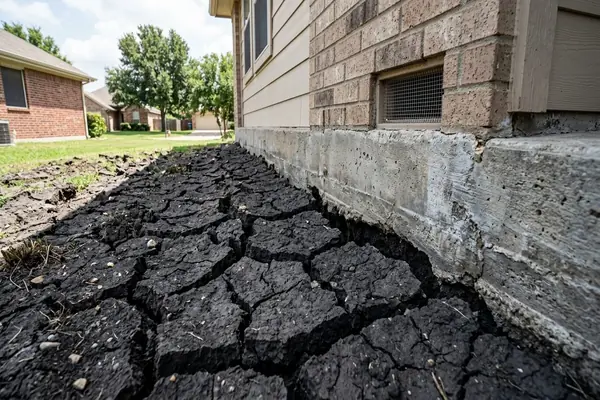
Why Denton County Clay Soil is So Aggressive
If you live in Denton, Corinth, Argyle, or Lake Dallas, your home is built directly atop one of the most volatile geological formations in the United States: The Texas Blackland Prairie Belt. This soil is rich in montmorillonite clay minerals, which exhibit extreme shrink-swell capacities.
During dry North Texas summers, when temperatures consistently exceed 95°F for weeks without rainfall, this clay soil desiccates rapidly. As moisture evaporates, the soil contracts and pulls away from concrete slab grade beams by up to 2 to 3 inches, leaving large subterranean voids beneath your foundation.
The Mechanical Sequence of Slab Settlement
A concrete slab foundation is not designed to bridge open air. When the perimeter supporting soil shrinks away, the weight of your brick veneer, roof framing, and load-bearing walls exerts tremendous downward shear stress. This results in:
- Differential Perimeter Settlement: One corner or side of the house sinks 0.75" to 2.5" lower than the central interior slab.
- Sheetrock Tensile Fractures: Diagonal cracks appearing above door frames, windows, and cathedral ceilings.
- Plumbing Ruptures: Cast iron or PVC drain lines beneath the slab snap under bending deflection.
- Exterior Brick Separation: Stair-step cracking zigzagging through masonry mortar joints.
Why Surface Watering and Mudjacking Fail
Many homeowners attempt to resolve settlement by injecting polyurethane foam (polyjacking) or mudjacking. While these techniques can temporarily lift flat exterior driveways, they do not solve structural foundation settlement because they rest on the same volatile active clay layer. As soon as the next Texas drought arrives, the injected slurry sinks right alongside the native soil.
The Engineered Solution: Hydraulic Steel & Pressed Concrete Pilings
Permanent structural stabilization requires bypassing the entire active moisture zone (typically 12 to 22 feet deep in Denton County) until refusal is achieved against load-bearing limestone bedrock or dense shale:
1. Pressed Concrete Pilings
Interlocking concrete cylinders hydraulically driven into the earth beneath exterior grade beams, secured with steel rebar and heavy-duty steel shims.
2. Helical & Double-Walled Steel Piers
High-strength structural steel shafts driven deep through Blackland clay into competent limestone bedrock, providing maximum resistance against North Texas drought cycles.
Need a Professional Engineering Assessment in Denton?
Don't let shifting North Texas clay soil compromise your property's value. Our licensed Denton structural specialists provide 100% free on-site elevation inspections with written transferable warranties.